


Starting work in adult social care can feel a little strange at first.
You may be helping someone with an ordinary part of their day — getting dressed, preparing a meal, attending an appointment or making a decision — yet the way you offer that support can affect their independence, dignity and safety.
That is why good care involves more than simply being kind.
You need to understand your role, communicate properly, recognise safeguarding concerns, respect people's choices, handle information safely and know where your responsibilities begin and end.
The Level 2 Adult Social Care Certificate brings these areas together within a recognised qualification for people working in adult social care.
But it is often confused with the Care Certificate, and there is another important point to understand: this is not simply an online theory course that can always be completed away from a care setting.
This guide explains what the qualification is, what you study, how assessment works, who it is designed for and what to check before choosing a course.
What Is the Level 2 Adult Social Care Certificate?
The Level 2 Adult Social Care Certificate is a vocational qualification designed around the knowledge, skills and behaviours expected in adult social care roles.
The qualification was introduced to create a clearer baseline of occupational knowledge and competence across the sector.
The Qualifi Level 2 Adult Social Care Certificate, offered through Direct Skills, is an RQF Level 2 qualification with qualification number 610/4201/8.
Unlike a short awareness course, the qualification covers a broad range of day-to-day care responsibilities. These include:
-
understanding your role;
-
duty of care;
-
communication;
-
person-centred working;
-
privacy and dignity;
-
safeguarding;
-
equality and human rights;
-
nutrition and hydration;
-
mental health and dementia;
-
infection prevention and control;
-
handling information;
-
health and safety;
-
learning disability and autism.
The important word here is competence.
You are not only expected to understand some aspects of good care. Where the assessment criteria require it, you must also show that you can apply what you know appropriately in practice.
You can view the current Level 2 Adult Social Care Certificate offered by Direct Skills for specific course information.
Why Was the Level 2 Adult Social Care Certificate Introduced?
For years, the Care Certificate standards have helped employers introduce people to the knowledge, skills and behaviours expected in health and social care.
There was, however, a practical problem.
Training completed with one employer was not always accepted by another. Someone moving to a new care provider could therefore find themselves repeating learning they had already completed.
The Level 2 Adult Social Care Certificate was developed partly to create greater consistency and recognition across the adult social care workforce.
Skills for Care describes it as a recognised qualification designed to provide a baseline standard, improve portability between employers and give formal recognition to the work carried out by care professionals.
That makes the qualification different from simply collecting several short care-training certificates.
It brings related areas of practice together and requires formal assessment against defined standards.
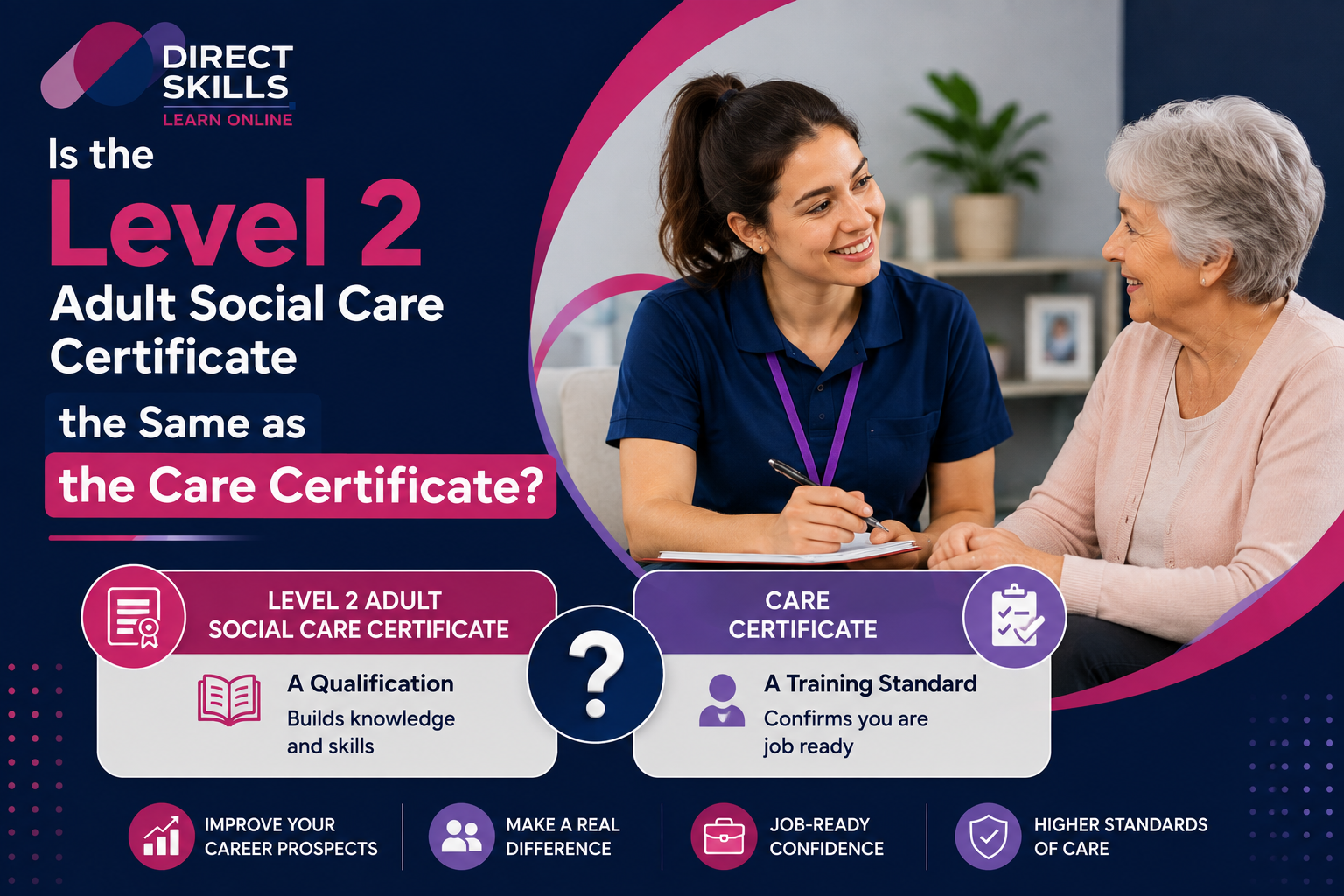
Is the Level 2 Adult Social Care Certificate the Same as the Care Certificate?
No. They are closely connected, but they are not the same thing.
This is one of the most important distinctions to understand.
The Care Certificate standards describe the knowledge, skills and behaviours expected from people working in particular health and social care roles. They are commonly used as part of induction for people who are new to care.
The Level 2 Adult Social Care Certificate is a regulated qualification.
It draws on the Care Certificate standards but develops the learning in greater depth and requires formal assessment.
A simple comparison helps.
| Care Certificate | Level 2 Adult Social Care Certificate |
|---|---|
| Standards used within care induction and development | Formal regulated qualification |
| Helps establish expected care knowledge and behaviours | Develops and assesses knowledge and occupational competence |
| Used by employers within workplace learning | Awarded through an approved awarding organisation |
| Not the same as completing an RQF qualification | Sits at RQF Level 2 |
| Assessment is linked to the standards | Formal assessment requirements must be met |
The two therefore complement one another, but they should not be described as interchangeable.
The Care Certificate standards were also updated in March 2025 and now contain 16 standards, including awareness of learning disability and autism.
What Do You Study?
The Qualifi Level 2 Adult Social Care Certificate contains 15 mandatory units.
Each one deals with an area that connects directly with adult social care practice.
1. Understand Your Own Role
Before you can provide good care, you need to understand what you are actually responsible for.
This includes your duties, agreed ways of working, professional boundaries and the standards that apply to your role.
Knowing your limits is particularly important.
Good care does not mean trying to solve every problem yourself. Sometimes professional practice means recognising when something needs to be reported, referred or handled by somebody with different responsibilities.
2. Personal Development
Care work involves continuous learning.
This unit looks at feedback, development needs and how a personal development plan can help you improve your practice over time.
It encourages you to think beyond simply completing training and instead ask:
What do I need to become better at, and how will I get there?
3. Duty of Care
A duty of care means having responsibilities towards the people you support.
That can sound straightforward until someone's wishes appear to conflict with concerns about safety.
This unit introduces situations where rights, choices and professional responsibilities need to be considered carefully. It also covers areas such as complaints, errors, incidents and learning from what goes wrong.
4. Equality, Diversity, Inclusion and Human Rights
People receiving care do not lose their individuality because they need support.
Their culture, beliefs, identity, communication needs, relationships and personal choices remain important.
This unit examines discrimination, inclusion and how care services can treat people fairly while responding to different needs.
5. Work in a Person-Centred Way
Person-centred care starts with the person rather than the service.
Instead of asking only, “What tasks need to be completed?”, good care also asks:
What matters to this individual?
The unit considers how people's wishes, preferences, identity and independence should influence the support they receive.
6. Communication
Communication in care is not limited to conversation.
A person may communicate through speech, writing, gestures, behaviour, pictures, assistive technology or other methods.
Care workers need to recognise communication needs and know how poor communication can affect safety, relationships and a person's involvement in their own care.
7. Privacy and Dignity
Needing help does not remove someone's right to privacy.
This unit considers how dignity can be protected during everyday support and why seemingly small choices — knocking before entering, explaining what you are doing or keeping personal information private — matter.
8. Nutrition and Hydration
Food and drink can affect health, independence and wellbeing.
The unit develops understanding of food safety, hydration and how care workers can support individuals to eat and drink appropriately while respecting their needs and preferences.
9. Awareness of Mental Health and Dementia
Care workers may support people living with mental health conditions or dementia.
The focus is not on becoming a clinician. It is about developing enough awareness to recognise relevant changes, understand how conditions can affect individuals and provide appropriate support within your role.
10. Adult Safeguarding
Safeguarding is a central responsibility in adult social care.
The unit covers different forms and signs of abuse, adults at risk and the responsibilities involved when a concern is identified.
Safeguarding is not about conducting your own investigation. It is about recognising concerns and following the correct procedures.
11. Safeguarding Children
Adult care services do not exist in isolation.
Workers may come into contact with children through families, homes or other situations. The qualification therefore includes awareness of child safeguarding and factors that may increase the risk of abuse.
12. Health, Safety and Principles of Basic Life Support
Care environments contain responsibilities that should never be handled casually.
This area examines workplace health and safety and helps distinguish between tasks care workers can carry out and those requiring appropriate instruction, competence or specialist training.
13. Handling Information
Care records can contain highly personal information.
This unit explores confidentiality, secure information handling and the importance of keeping records accurate, complete and current.
14. Infection Prevention and Control
Infection prevention is part of everyday safe care.
You consider how infections can spread, your responsibilities for reducing risk and how your own health and hygiene can affect the people you support.
15. Awareness of Learning Disability and Autism
This area looks at some of the barriers experienced by people with learning disabilities and autistic people, including inequalities in accessing healthcare and support.
Its inclusion reflects a broader effort across the care sector to improve understanding and reduce inequalities.
Why Are All 15 Units Mandatory?
There is a reason you cannot simply select the subjects you like most.
These units represent connected areas of care practice.
Imagine supporting someone living with dementia who has stopped drinking enough water.
At first, that sounds like a nutrition and hydration issue.
But you may also need to consider:
-
how the person communicates;
-
whether they understand what is being offered;
-
their preferences;
-
changes in mental or physical health;
-
accurate record keeping;
-
dignity;
-
possible risks;
-
when concerns need to be escalated.
Real care does not divide neatly into modules.
The qualification does because that makes learning manageable. In practice, the knowledge has to work together.
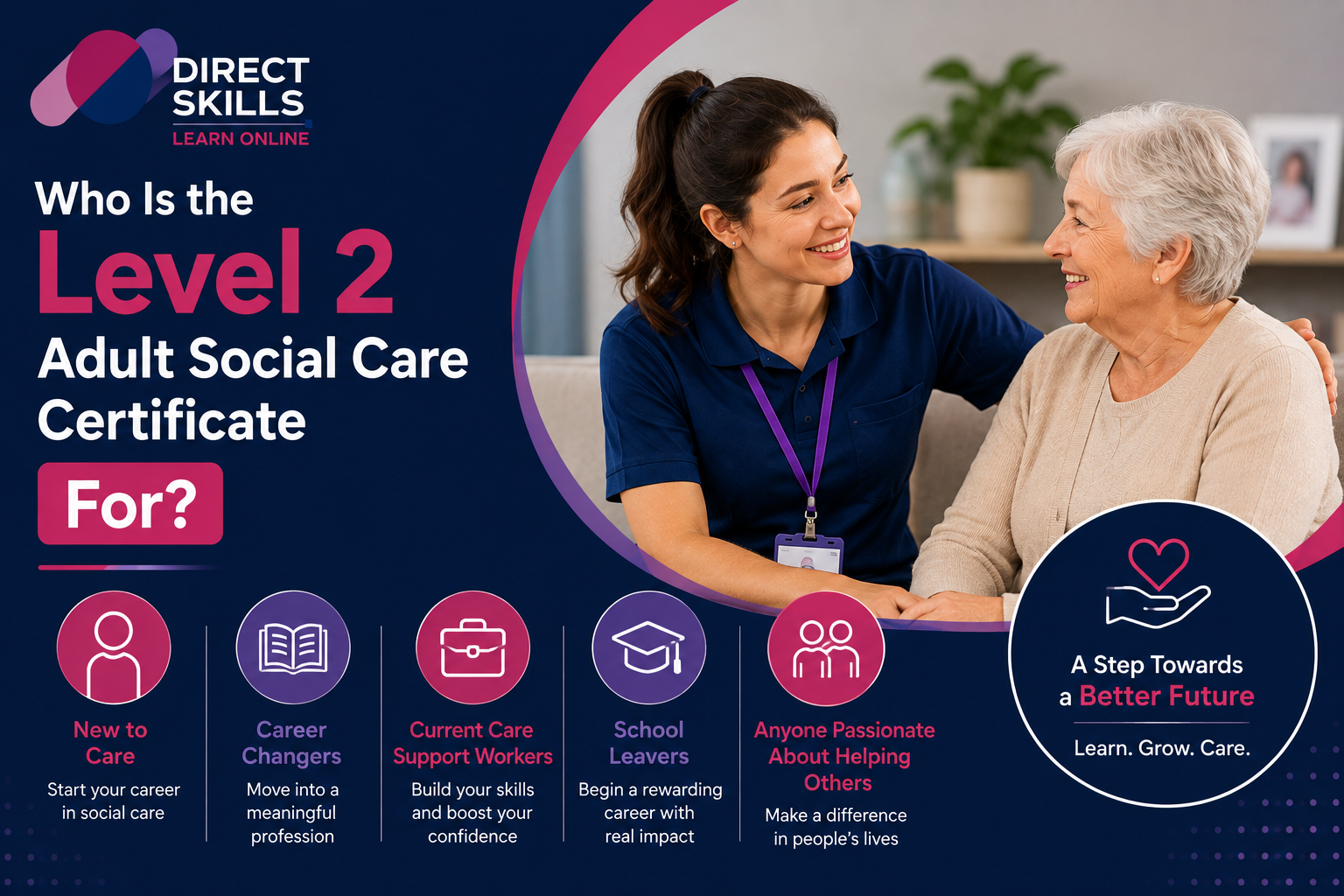
Who Is the Level 2 Adult Social Care Certificate For?
The qualification is particularly relevant to people working in, or entering, adult social care roles where they can develop and demonstrate the required occupational competence.
That may include people working as:
-
care workers;
-
care assistants;
-
support workers;
-
home care workers;
-
personal assistants;
-
other non-regulated adult social care staff.
It can also be useful for experienced workers who have built up considerable knowledge through practice but do not yet hold a relevant formal qualification.
Skills for Care particularly encourages employers to consider the qualification for staff who do not already hold a relevant care qualification.
Can You Take the Qualification If You Have Never Worked in Care?
This needs a more careful answer than simply saying “yes, beginners are welcome”.
The qualification can be suitable for someone new to care.
However, new to care does not necessarily mean you can complete every requirement entirely from home without access to care practice.
The qualification includes competencies that must be formally assessed, and Skills for Care's current assessment guidance requires direct observation for relevant criteria.
That means anyone considering the qualification should establish how the practical assessment requirements will be met.
Before enrolling, ask the provider:
-
Do I need to be employed or placed in an adult social care setting?
-
Which assessments require workplace evidence?
-
How will direct observation be arranged?
-
Who carries out the observation?
-
Can previous workplace evidence be considered?
-
What happens if I do not currently have access to a care setting?
These questions matter far more than whether the learning materials themselves are available online.
Can You Study the Level 2 Adult Social Care Certificate Online?
Much of the learning and theoretical work can be supported through online delivery.
For example, Direct Skills provides online access to learning materials, tutor support and course resources through its learning platform. You can review its Adult Care courses to see the available study routes.
But online delivery and online-only assessment are not the same thing.
The qualification includes practical competence, and some assessment requirements depend on evidence from actual practice.
Skills for Care states that direct observation is required for certain elements of the qualification. Other evidence can include approaches such as professional discussion, reflective accounts, questions, workplace products and recognised prior learning.
So when comparing providers, do not ask only:
“Can I study online?”
Also ask:
“How will my workplace competence be assessed?”
That is the more important question.
How Is the Level 2 Adult Social Care Certificate Assessed?
Assessment is designed to establish whether you have the required knowledge and competence.
Depending on the assessment criterion, evidence may come from different sources.
These can include:
-
written work;
-
questions and answers;
-
professional discussion;
-
reflective accounts;
-
work products;
-
recognition of prior learning;
-
workplace evidence;
-
direct observation.
Direct observation is particularly important where an assessor needs to see that you can carry out a required activity competently rather than simply explain it.
There is an important principle behind this.
If you were assessing whether somebody could drive safely, asking them to write an essay about driving would tell you something about their knowledge.
It would not prove that they could drive.
Care qualifications have the same distinction.
Some things can be demonstrated through knowledge. Others need evidence of practice.
Does the Qualification Have Exams?
Traditional written examinations are not the defining assessment method for this qualification.
Instead, assessment is built around evidence showing that the required learning outcomes and occupational competencies have been achieved.
However, it would be misleading to describe the qualification simply as “assignment-only” because some criteria require practical evidence and direct observation.
When comparing courses, read the provider's assessment information carefully and make sure it explains both the knowledge and practical requirements.
How Long Does the Level 2 Adult Social Care Certificate Take?
There is no single completion time that will apply equally to everybody.
Skills for Care advises that someone relatively new to adult social care may typically take around 6–8 months to complete the qualification.
An experienced care worker may be able to complete it sooner because relevant existing learning, training and workplace experience may be recognised where appropriate and properly evidenced.
This is why promises such as “finish in X months” need context.
Two people could start the same qualification on the same day.
One might have years of adult care experience and existing evidence.
The other might have just begun their first care role.
Their learning journeys should not necessarily look identical.
Can Previous Care Experience Count?
Potentially, yes.
Recognition of Prior Learning (RPL) allows relevant previous learning or evidence to be considered where it meets the requirements of the qualification.
This does not mean experience automatically gives you a unit.
Evidence still needs to be suitable, current enough where required, and capable of demonstrating that the assessment criteria have been met.
For experienced care workers, however, RPL can prevent unnecessary repetition and make the qualification reflect what they already know and can do.
Does the Qualification Replace Workplace Induction?
No.
Completing the Level 2 Adult Social Care Certificate does not remove an employer's responsibility to provide appropriate induction, mandatory training, supervision and organisation-specific learning.
Every care service has its own people, procedures, risks and ways of working.
A qualification can show that you have met recognised occupational standards.
It cannot teach you the fire procedure for a building you have never entered or introduce you to the individual support plans used by a new employer.
Skills for Care explicitly distinguishes the qualification from employer-specific induction and mandatory training.
What Can You Do After Level 2?
Completing Level 2 does not mean you have reached the end of your development in care.
Skills for Care's wider workforce approach expects care workers to continue developing beyond baseline Level 2 competence, with Level 3 forming an important next stage of occupational development.
Direct Skills currently offers a Level 3 Diploma in Adult Health and Social Care for people considering further study.
Whether Level 3 is the right next step depends on your:
-
current role;
-
previous qualifications;
-
experience;
-
employer requirements;
-
responsibilities;
-
longer-term career plans.
There is little value in collecting qualifications simply because the number increases.
Progression should make sense for the work you actually want to do.
Is the Level 2 Adult Social Care Certificate Recognised?
The Qualifi Level 2 Adult Social Care Certificate is an RQF Level 2 qualification with qualification number 610/4201/8. Qualifi is an awarding organisation recognised by Ofqual.
Skills for Care has also approved Level 2 Adult Social Care Certificate qualifications developed against its sector criteria. The qualification is now positioned as an important baseline qualification for people entering adult social care.
That is a much more useful meaning of “recognised” than simply saying employers value a course.
When researching any qualification, check:
Who regulates it?
Who awards it?
What is its qualification number?
Does it meet the relevant sector standard?
Those details give you something concrete to verify.
Level 2 Adult Social Care Certificate or Level 2 Diploma in Care?
These titles can easily cause confusion when searching online.
Skills for Care states that the newer Level 2 Adult Social Care Certificate is now its recognised and preferred standard for care professionals entering the sector, and it is moving away from the older Level 2 Diploma in Care as part of this transition.
Older Level 2 Diploma in Care achievements do not suddenly become meaningless.
However, somebody choosing a qualification now should check the current sector position rather than relying on an old article or course listing.
Adult social care qualifications are changing, which makes the date and awarding details of online information particularly important.
What Should You Check Before Enrolling?
Course pages naturally tell you what is attractive about a qualification.
Your job is to check the parts that determine whether it will actually work for you.
1. Check the Exact Qualification
For the course discussed here, the qualification is:
Qualifi Level 2 Adult Social Care Certificate
Qualification number:
610/4201/8
2. Check How Practical Assessment Works
Ask specifically about workplace observation.
Do not assume that “online course” means all competence can be assessed through online assignments.
3. Check Whether You Need Access to a Care Setting
If you are not currently working in care, find out how the provider expects you to produce the necessary workplace evidence.
4. Check What Previous Learning Can Count
If you already work in care, ask whether relevant previous training and workplace evidence can be considered through RPL.
5. Check the Realistic Completion Time
Ask whether the advertised timeframe assumes previous experience.
A shorter completion time for an experienced worker does not necessarily represent a realistic schedule for someone who has just entered care.
6. Check What Comes Next
If you already know you want to progress to Level 3, compare the entry and progression requirements before enrolling.
7. Check the Awarding Organisation
Direct Skills offers qualifications from recognised awarding organisations including Qualifi. You can read more about Qualifi qualifications before choosing a course.
Is the Level 2 Adult Social Care Certificate Worth Doing?
It can be.
But its value depends on why you are taking it.
If you work in adult social care without a relevant formal qualification, it can provide a structured way to have your knowledge and competence assessed and recognised.
If you are new to care, it can help build a consistent foundation while you develop experience in the workplace.
And if you want to continue towards Level 3, it can form part of a sensible progression route.
What it should not be treated as is a quick online certificate that automatically produces a care career.
Good care work involves responsibility.
The qualification reflects that.
You need to understand the person you support, recognise the limits of your role, communicate clearly, protect confidential information, respond appropriately to concerns and demonstrate that what you know can be applied in practice.
That is precisely why choosing the right Level 2 course is about more than finding the shortest completion time.
If you are considering this route, review the full Level 2 Adult Social Care Certificate and confirm how its practical assessment requirements will apply to your circumstances before enrolling.
Frequently Asked Questions
Q1. Is the Level 2 Adult Social Care Certificate the same as the Care Certificate?
No. The Level 2 Adult Social Care Certificate is a regulated qualification that builds on the Care Certificate standards in greater depth and includes formal assessment. The Care Certificate standards are commonly used within induction and workforce development.
Q2. Is the Level 2 Adult Social Care Certificate an Ofqual-regulated qualification?
The Qualifi Level 2 Adult Social Care Certificate is an RQF Level 2 qualification. Qualifi is recognised by Ofqual as an awarding organisation.
Q3. What is the qualification number?
The Qualifi Level 2 Adult Social Care Certificate has qualification number 610/4201/8.
Q4. Can I complete the qualification entirely online?
Learning materials and knowledge-based work can be delivered online, but relevant occupational competencies require appropriate assessment. Current Skills for Care requirements include direct observation for certain assessment criteria, so you should confirm how workplace evidence will be arranged.
Q5. Do I need to work in adult social care?
The qualification is designed around adult social care practice and includes competencies that require evidence. If you are not currently working in an appropriate setting, ask the provider how these requirements can be met before enrolling.
Q6. How long does the Level 2 Adult Social Care Certificate take?
Skills for Care indicates that a person relatively new to adult social care may typically take around 6–8 months. Experienced care workers may complete it sooner where relevant previous learning and evidence can be recognised.
Q7. Are there exams?
The qualification is assessed through evidence of knowledge and competence rather than relying on a traditional final examination. Assessment methods can include written evidence, professional discussion, workplace evidence, RPL and direct observation.
Q8. Can previous care experience count towards the qualification?
Relevant previous learning, training and workplace evidence may potentially be recognised through RPL where it meets the qualification's assessment requirements.
Q9. What can I study after Level 2?
Progression may include a relevant Level 3 adult care qualification. Direct Skills offers a Level 3 Diploma in Adult Health and Social Care for those considering the next stage.
Q10. Does completing Level 2 guarantee a care job?
No qualification can guarantee employment. Employers may consider experience, competence, references, right-to-work requirements, safeguarding checks, mandatory training and the specific requirements of the role alongside qualifications.
