


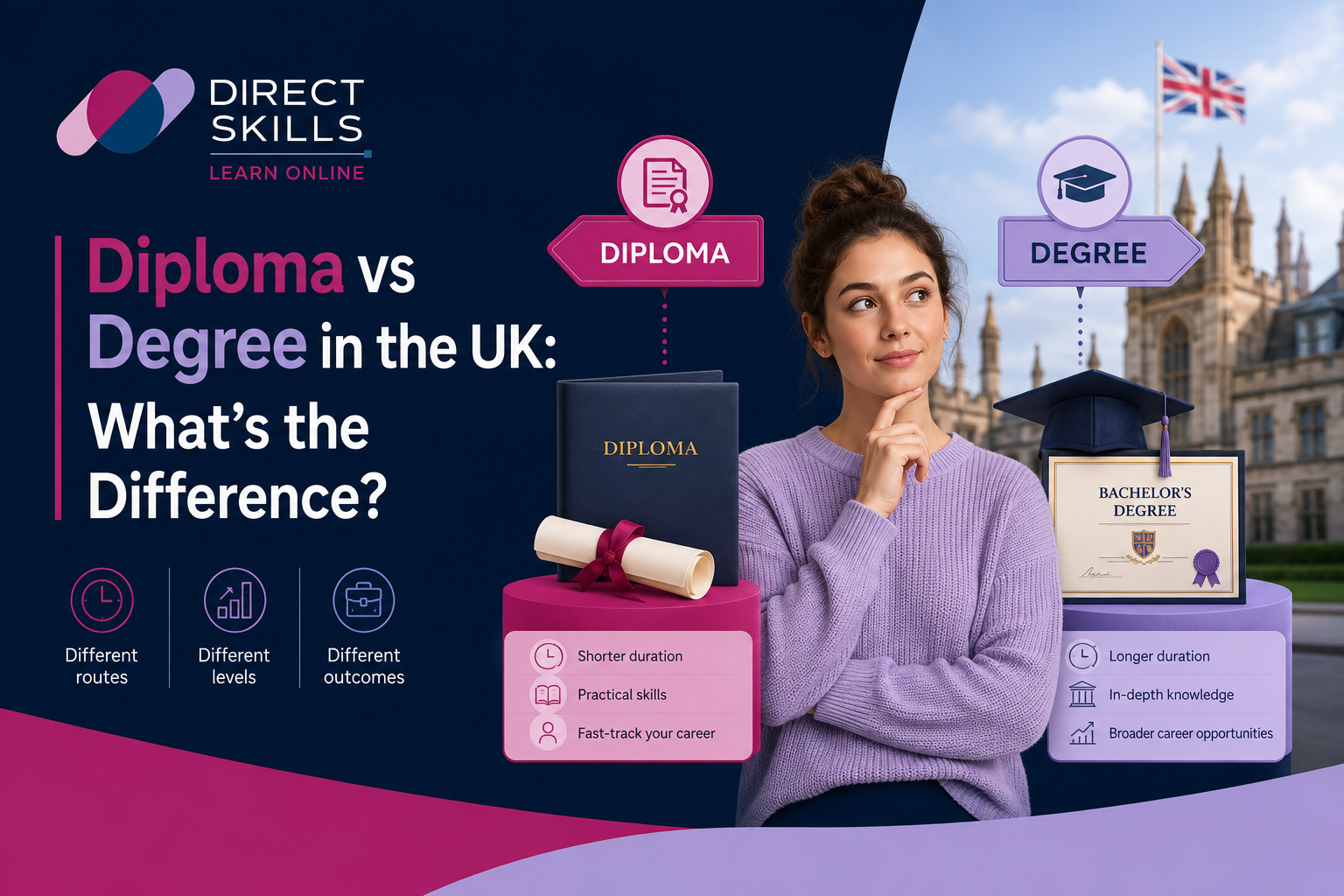
A diploma is not automatically lower than a degree.
That is the first thing to understand.
In the UK, a Level 6 Diploma and a bachelor's degree can both sit at Level 6. A Level 7 Diploma and a master's degree can both sit at Level 7. Yet those qualifications are not the same.
Confusing? A little.
The reason is simple: qualification level tells you how difficult the learning is. It does not tell you that two qualifications are identical.
So, when comparing a diploma vs degree, you need to look beyond the name. You should compare the qualification level, size, subject, assessment, awarding body and what the qualification allows you to do next.
This guide explains those differences clearly so you can make a more informed choice.
Note: This guide mainly uses the qualification levels applied in England, Wales and Northern Ireland. Scotland uses a different qualifications framework.
Diploma vs Degree: What Is the Main Difference?
A diploma is a type of qualification that can exist at several different qualification levels. Depending on the programme, it may be vocational, professional, technical or designed for further academic progression.
A degree is a higher education award. Common examples include a foundation degree, bachelor's degree, master's degree and doctorate.
The biggest mistake is to assume that:
Diploma = lower qualification and Degree = higher qualification
That is not always true.
You first need to ask: What level is the diploma?
GOV.UK lists diplomas across several qualification levels, while bachelor's degrees are normally Level 6, master's degrees Level 7 and doctorates Level 8. Qualifications at the same level can still differ in how much material they cover.
What Is a Diploma in the UK?
A diploma is a qualification awarded after completing a defined programme of study and assessment.
But there is no single “diploma level”.
You can find diplomas at:
-
Entry Level
-
Level 1
-
Level 2
-
Level 3
-
Level 4
-
Level 5
-
Level 6
-
Level 7
-
Level 8
That means the word diploma alone tells you surprisingly little about how advanced a qualification is.
For example:
-
a Level 2 Diploma and a Level 7 Diploma are both called diplomas;
-
their level of difficulty is clearly very different;
-
their entry requirements, subject depth and progression routes can also be very different.
This is why you should never choose a course simply because the word “Diploma” appears in its title.
Look at the number beside it.
Then look at who awards it and what it contains.
What Is a Degree?
A degree is a higher education qualification awarded by an institution with the appropriate degree-awarding powers.
In England, providers need formal degree-awarding powers to award degrees. A college can sometimes teach a degree even though another higher education institution actually awards it.
Common degree types include:
-
Foundation Degree – Level 5
-
Bachelor's Degree – Level 6
-
Master's Degree – Level 7
-
Doctorate / PhD – Level 8
An academic degree might consist of lectures, self-study, coursework, research, exams, projects, practical training, or placement, depending on what subject it is about.
Degrees in engineering and nursing might be particularly rich in practical training.
A degree in history might rely mainly on reading and research.
Therefore, the equation of: degree = theory
as much as this one: diploma = practical
makes no sense at all.
Before Comparing Them, Understand Level and Size
This is the part many diploma-vs-degree comparisons leave out.
A qualification has more than one characteristic.
Two of the most useful are:
Level
The level tells you about the difficulty and complexity of the learning.
GOV.UK explains that higher qualification levels represent more difficult learning.
Size
The size gives you an estimate of the learning and assessing included in the qualification.
Learning and assessing are different.
Picture two walking trails, both leading to the same altitude.
One will take you two hours and the other will take you eight.
The destination is the same, but the experience is quite different.
So it can be for qualifications at the same level.
They may demand learning at a similar level of difficulty while differing significantly in:
-
study time;
-
credits;
-
subject coverage;
-
assessment;
-
purpose.
That is why same level does not mean same qualification.
Why Is It Called a Diploma?
For qualifications regulated under Ofqual's conditions, terms such as Award, Certificate and Diploma can indicate the size of the qualification.
Ofqual's guidance uses:
-
Award for qualifications with up to 120 hours of Total Qualification Time;
-
Certificate for 121–369 hours;
-
Diploma for qualifications with 370 hours or more.
Total Qualification Time (TQT) estimates the total time someone would reasonably need to complete the learning and assessment required for the qualification.
This gives you another important lesson:
The word Diploma can tell you something about qualification size in this context.
It still does not tell you the qualification level.
A Level 3 Diploma and Level 7 Diploma may both be large qualifications, but the Level 7 learning is much more advanced.
Diploma vs Degree: Quick Comparison
| What to compare | Diploma | Degree |
|---|---|---|
| Qualification type | Can be vocational, professional, technical or academic | Higher education degree |
| Qualification level | Can exist at several levels | Depends on degree type |
| What the title tells you | “Diploma” does not tell you the level by itself | Degree type normally indicates a higher education award |
| Typical provider | May be studied through colleges, approved centres, universities or training providers | Usually studied through a higher education provider |
| Who awards it | An awarding organisation or institution, depending on the qualification | A body with appropriate degree-awarding powers |
| Study style | Depends on the qualification | Depends on the degree and subject |
| Assessment | May include assignments, projects, exams, research or practical evidence | May include essays, exams, projects, research, placements or practical work |
| Duration | Varies significantly | Depends on degree type and study mode |
| Progression | May lead to employment or higher-level study | May lead to postgraduate study, employment or professional routes |
| Best choice | Depends on your starting point and goal | Depends on your starting point and goal |
The most important row is the last one and there is no universal winner.
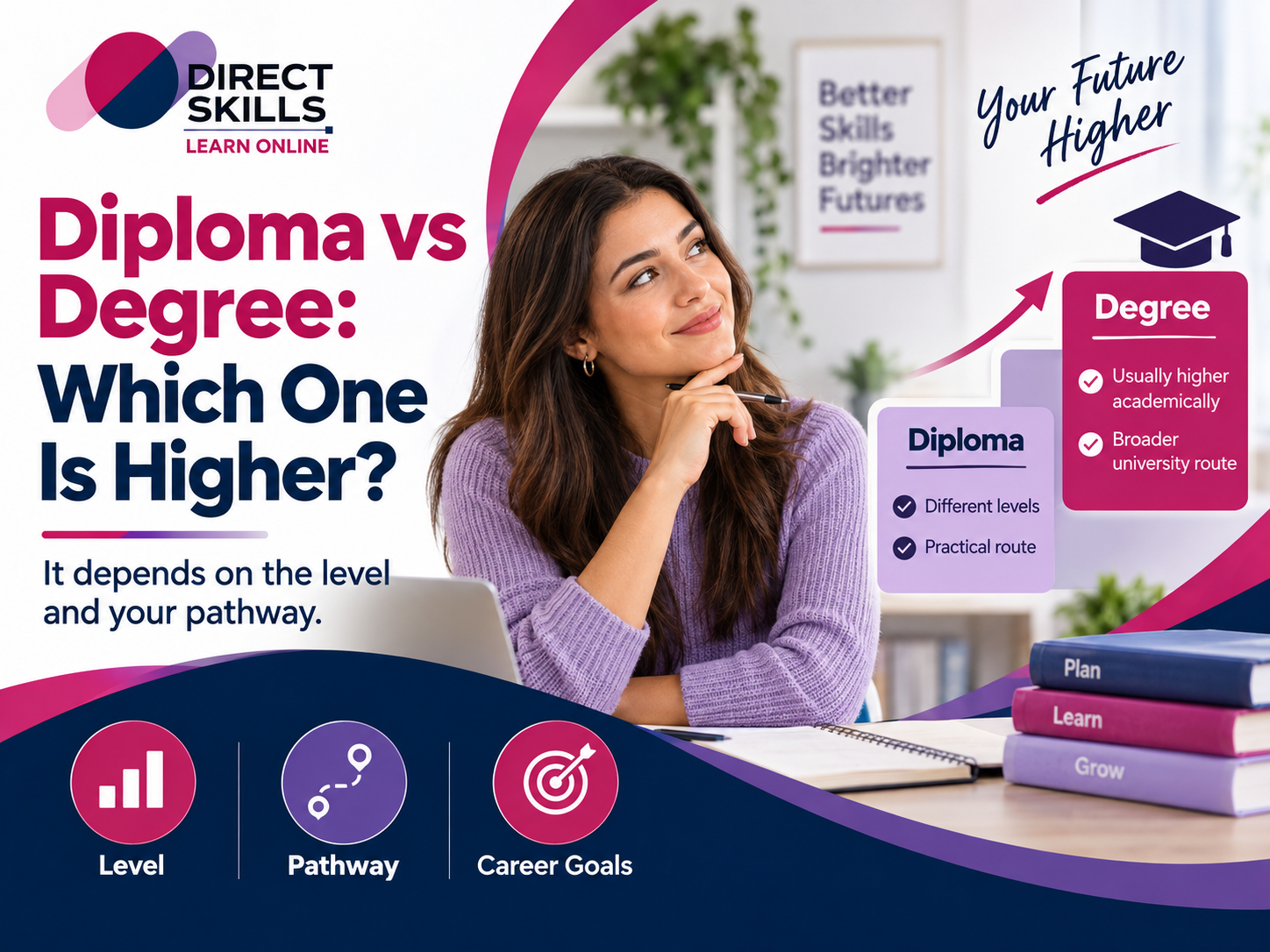
Diploma vs Degree: Which One Is Higher?
Neither is automatically higher. Compare the qualification levels.
This becomes much easier when you look at examples.
Level 5
Examples of Level 5 qualifications include:
-
Level 5 Diploma
-
Foundation Degree
-
Higher National Diploma (HND)
-
Diploma of Higher Education (DipHE)
These can sit at the same qualification level, but they are different awards with different structures and purposes.
Level 6
Examples include:
-
Level 6 Diploma
-
Bachelor's Degree
-
Degree Apprenticeship
-
Level 6 NVQ
A Level 6 Diploma and bachelor's degree can therefore sit at the same level of difficulty.
That does not turn the diploma into a bachelor's degree.
Level 7
Examples include:
-
Level 7 Diploma
-
Master's Degree
-
Postgraduate Diploma
-
PGCE
-
Level 7 NVQ
Again:
same level ≠ same qualification.
That single rule clears up much of the confusion around diploma and degree equivalence.
Is a Level 5 Diploma Equivalent to a Degree?
This needs careful wording.
A Level 5 Diploma is at Level 5.
A full bachelor's degree is normally Level 6.
Level 5 also includes qualifications such as:
-
Foundation Degrees;
-
HNDs;
-
Diplomas of Higher Education.
It is therefore more accurate to say that a Level 5 Diploma is a higher-level qualification below the level of a completed bachelor's degree, rather than calling it a degree equivalent.
Some Level 5 qualifications may support progression into later stages of university study, but that depends on the exact qualification and university.
Is a Level 6 Diploma the Same as a Bachelor's Degree?
No.
A Level 6 Diploma and bachelor's degree can both sit at Level 6.
This means the learning is assessed at the same framework level.
It does not mean:
-
they contain the same number of credits;
-
they cover the same amount of study;
-
they use the same assessments;
-
employers must treat them identically;
-
the diploma becomes a BA or BSc.
A qualification can be at bachelor's degree level without being a bachelor's degree.
That distinction is important when checking university entry, jobs and professional requirements.
Is a Level 7 Diploma the Same as a Master's Degree?
Again, no.
Level 7 Diplomas and master's degrees can both sit at Level 7.
The level tells you that both involve advanced learning.
It does not make the qualifications interchangeable.
A master's degree may include a different credit structure, research requirements and final award.
So instead of saying:
“A Level 7 Diploma is a master's degree.”
say:
“A Level 7 Diploma sits at the same qualification level as a master's degree, but it is a different qualification.”
That wording is both clearer and more accurate.
Are Diplomas More Practical Than Degrees?
Sometimes, but not always.
Many vocational and professional diplomas are designed around a particular occupation or field.
That can make the learning feel closely connected to work.
But diplomas can also require:
-
research;
-
academic reading;
-
essays;
-
reports;
-
analysis;
-
evaluation;
-
projects.
Likewise, degrees can contain highly practical learning.
Think about:
-
nursing;
-
engineering;
-
architecture;
-
teaching;
-
laboratory science.
Those degrees may include placements, practical assessments, projects or supervised professional experience.
So instead of deciding based on:
practical vs academic
look at the actual module list and assessment methods.
That will tell you far more.
Is a Diploma Shorter Than a Degree?
It can be, but you should not assume it will be, a full-time bachelor's degree in the UK commonly involves several years of study.
A diploma may take less time, particularly when it has a narrower scope or is delivered flexibly.
But some diplomas are substantial qualifications in their own right.
The useful figures to check are:
-
credit value;
-
Total Qualification Time;
-
Guided Learning Hours;
-
number of modules;
-
provider's study schedule.
If one provider advertises a course as “fast”, ask what that means in practice.
Finishing sooner usually means completing the required learning and assessment over a shorter period. It does not remove the requirements of the qualification.
Can a Diploma Lead to a Degree?
Yes, some diplomas can support progression to degree study. But there is no universal diploma-to-degree conversion.
This is an important distinction.
Depending on the qualification, progression could mean:
-
applying to university after Level 3;
-
progressing from Level 4 to Level 5;
-
receiving advanced entry after a relevant Level 4 or Level 5 qualification;
-
progressing through a recognised top-up route.
But whether that happens depends on:
-
the exact diploma;
-
its level;
-
its credit value;
-
the subject;
-
awarding organisation;
-
university;
-
degree programme;
-
admissions policy.
Universities make their own admissions decisions.
If you are studying a diploma specifically because you eventually want a degree, work backwards.
First choose the university course you want, then ask whether it accepts the diploma you are considering.
That ten-minute check can prevent a very expensive misunderstanding.
Can You Get a Job With a Diploma in the UK?
Yes, but the answer depends on the diploma and the job.
Employers may consider:
-
qualification level;
-
subject;
-
experience;
-
practical competence;
-
awarding organisation;
-
professional requirements;
-
previous employment;
-
other licences or registrations.
A Level 3 diploma in one subject clearly does not have the same career use as a Level 7 diploma in another.
Some jobs may accept or value relevant vocational qualifications and other careers require a specific degree.
And some regulated professions require much more than simply holding a qualification at a certain level.
For example, a qualification being at Level 6 does not automatically make it suitable for a profession that specifically requires an approved bachelor's degree and professional registration.
Always check the job requirement, not just the framework level.
When Might a Diploma Make More Sense?
A diploma may be worth considering when:
-
you want to study a specific professional subject;
-
the exact qualification supports your intended career or study route;
-
you already work and need a more flexible study pattern;
-
you want to progress through qualification levels;
-
the course's assessment method suits you;
-
you do not specifically require a university degree;
-
you want a recognised route into further study.
The important phrase is the exact qualification.
Do not choose “a diploma”.
Choose a specific diploma with a clear purpose.
When Might a Degree Make More Sense?
A degree may be the better route when:
-
your intended profession specifically requires one;
-
you want a university degree as your final award;
-
you want the wider academic experience offered by a particular programme;
-
your career pathway requires an approved degree;
-
you intend to move into postgraduate or research study;
-
the university route is the clearest way to reach your goal.
Again, this is not about one route being more impressive.
It is about whether it takes you where you need to go.

Diploma or Degree: Which Is Better for Your Career?
Start with the career, not the qualification.
Suppose two people are choosing what to study.
The first wants a profession that requires a specific university degree.
The second already works in management and wants to develop higher-level professional knowledge while continuing to work.
Giving both people the same advice would make little sense.
Before choosing, ask:
1. What job do I actually want?
Look at current entry requirements for that role.
2. Is a degree specifically required?
If yes, check what type.
3. Would a regulated diploma meet the requirement instead?
Do not guess. Verify it.
4. What qualifications do I already hold?
There is little point starting at a level you have already passed unless the subject or progression route gives you a good reason.
5. What do I want to do after the course?
Look beyond enrolment.
Ask what the qualification leads to.
How to Check a Diploma Before You Enrol
A course page can look convincing while still leaving out the information you need most.
Before enrolling in any diploma, check these six things.
The Full Qualification Name
Do not rely on abbreviated marketing titles.
Qualification Level
Is it Level 3, 4, 5, 6 or 7?
The number matters.
Awarding Organisation
Find out who actually awards the qualification.
Direct Skills, for example, provides qualifications from awarding organisations including OTHM and Qualifi. Both the provider and awarding organisation have different roles.
Regulation
If the course is being presented as a regulated UK qualification, verify its regulatory status.
Assessment
Check whether the qualification uses:
-
coursework;
-
examinations;
-
projects;
-
presentations;
-
research;
-
observations;
-
practical evidence.
Do not assume every diploma is assessed in the same way.
Progression
If the provider says the diploma “can lead to university”, ask:
Which universities? Which degree? At what stage? Under what entry requirements?
A specific answer is more useful than a broad promise.
Awarding Organisation vs College: What Is the Difference?
This is another source of confusion.
The organisation where you study is not always the organisation that awards your qualification.
For example, an approved college or training centre may:
-
provide teaching;
-
give access to learning materials;
-
support assessment;
-
provide tutor guidance.
The awarding organisation may:
-
design or regulate the qualification;
-
set assessment requirements;
-
quality-assure approved centres;
-
issue the final qualification.
A similar distinction exists with degrees.
GOV.UK notes that not every college teaching a degree can award that degree itself. Another recognised higher education institution may make the award.
This is why checking who teaches and who awards is always worthwhile.

What Diploma Levels Can You Study Through Direct Skills?
Direct Skills offers online qualifications across several subject areas and levels, including:
-
Health and Social Care
-
Adult Care
-
Business Management
-
Law
-
Cyber Security
-
Information Technology
-
Accounting and Finance
-
Psychology
-
Data Science
-
Health and Safety
-
Child Care
You can view all Direct Skills courses and compare the exact qualification level, entry requirements and progression information before choosing a programme.
You will also find examples ranging from lower-level introductory qualifications to advanced diplomas at Levels 6, 7 and 8 in the current Direct Skills course structure.
That range illustrates the central point of this guide:
“Diploma” does not describe one level of education.
Always read the full title.
Diploma vs Degree: Five Questions to Ask Yourself
Still unsure?
Use these questions.
Do I need a specific qualification for my career?
If a job requires a degree, find out exactly which degree.
What level am I currently at?
Your previous qualifications can help determine the sensible next step.
Do I want professional development or a university degree?
Those goals can lead to different choices.
How do I want to study?
Check the actual delivery and assessment method rather than assuming every diploma is flexible or every degree requires daily campus attendance.
Where do I want to be after this qualification?
This is usually the most useful question.
A qualification should make sense because of what comes after it, not because its name sounds impressive.
Diploma vs Degree: Final Answer
So, what is the difference between a diploma and a degree?
A diploma is a qualification type that can exist at many different levels. Depending on the programme, it may support professional development, employment or progression to further study.
A degree is a higher education award such as a foundation degree, bachelor's degree, master's degree or doctorate.
Neither term tells the whole story on its own.
A Level 6 Diploma and bachelor's degree can sit at the same qualification level without being the same qualification.
A Level 7 Diploma and master's degree can do the same.
The right comparison is therefore not simply:
Diploma vs degree?
It is:
What level is it? How large is it? Who awards it? What does it teach? How is it assessed? And where can it take me next?
Answer those questions, and choosing between the two becomes much easier.
Frequently Asked Questions
Q1. Is a diploma better than a degree?
Neither is automatically better. The right choice depends on the qualification level, subject and what you need for your intended career or further study.
Q2. Is a diploma lower than a degree?
Not necessarily. Diplomas exist at several qualification levels. A Level 6 Diploma and bachelor's degree can both sit at Level 6, while a Level 7 Diploma and master's degree can both sit at Level 7. They remain different qualifications.
Q3. Is a Level 5 Diploma a degree?
No. A Level 5 Diploma is a Level 5 qualification. Foundation Degrees and HNDs also sit at Level 5, while a completed bachelor's degree normally sits at Level 6.
Q4. Is a Level 6 Diploma equivalent to a bachelor's degree?
A Level 6 Diploma and bachelor's degree can be at the same qualification level, but the diploma is not automatically a bachelor's degree. Their size, content, assessment and award can differ.
Q5. Is a Level 7 Diploma equivalent to a master's degree?
A Level 7 Diploma and master's degree can sit at the same qualification level. However, they are different qualifications and may differ in credits, study structure and progression.
Q6. Can I get a job with a diploma in the UK?
Yes, depending on the qualification and job. Employers may consider the level, subject, experience and relevance of the diploma. Some professions specifically require a degree or professional registration.
Q7. Can a diploma lead to a degree?
Yes, some diplomas can support progression to university or advanced entry. Acceptance depends on the exact qualification and the university's entry requirements.
Q8. Are diplomas shorter than degrees?
Some are, but not all. Diploma size varies considerably. Check the qualification's credits, Total Qualification Time and provider study schedule before comparing duration.
Q9. Are diplomas more practical than degrees?
Some vocational diplomas have a strong practical or professional focus, but this is not true of every diploma. Degrees can also contain placements and practical assessment. Check the curriculum rather than relying on the qualification title.
Q10. Can you study a diploma online?
Many diploma qualifications are available through online or distance learning. Whether a particular qualification can be completed fully online depends on its assessment and practical requirements.
